
Search Marion County Court Records
The main online route for many Marion County Court records is the South Carolina Judicial Branch case-record search and the county Public Index. Marion County is listed in Judicial Circuit 12 and County Number 33. The official search hub says cookies and JavaScript must be enabled, and some users need a browser pop-up exception before case details open. That matters because a blank result may be a browser or access problem, not proof that no case exists.
Before searching, identify the record type. Circuit civil and General Sessions criminal files normally route through the Clerk of Court and the trial Public Index. Family Court has its own public records portal and stricter limits for juvenile, adoption, custody, and support material. Probate Court handles estates and marriage licenses without a Marion online probate search located in the research. Traffic tickets may be in Magistrate Court or a city Municipal Court, and jail custody records are Detention Center records rather than court case files.
- Start with the record type: civil lawsuit, criminal case, divorce, probate, traffic, warrant, jail custody, marriage, or deed-related recording.
- Use the court or agency name on the notice, ticket, summons, bond paper, or case number to choose the right channel.
- For public court cases, use the Marion County Public Index first, then use court rosters when the question is about a hearing date.
- For records not online, contact the legal custodian for inspection, ordinary copies, certified copies, or older file research.
- For county administrative, sheriff, detention, and non-court records, use the written FOIA request process when no direct portal exists.
The South Carolina Judicial Branch Marion courthouse listing is the official state court directory for local court contacts.
Use that listing to confirm which court owns the Marion County Court record before relying on a database result or mailing a payment.
Marion County Court System
South Carolina uses Circuit Court as its general-jurisdiction trial court. In Marion County, Circuit Court includes Common Pleas for civil matters and General Sessions for criminal matters. Family Court handles divorce, custody, support, alimony, adoption, name changes, termination of parental rights, and most juvenile matters. Probate Court handles estates, wills, marriage licenses, guardianships, conservatorships, trusts, minor settlements, powers of attorney, and involuntary commitments.
Lower court work is split between Magistrate Court and Municipal Court. Magistrate Court handles small civil claims up to $7,500, lower-level criminal and traffic matters, bail, preliminary hearings, arrest warrants, and search warrants. Municipal Courts in Marion, Mullins, Nichols, and Sellers handle city ordinance and qualifying low-level criminal or traffic cases inside city limits. Appeals from Probate, Magistrate, and Municipal Courts can move to Circuit Court. Appeals from Circuit and Family Court generally move to the South Carolina Court of Appeals or Supreme Court.
Case flow: Magistrate or Municipal Court › Circuit Court appeal when allowed › Court of Appeals or Supreme Court. Circuit civil and criminal cases begin in Circuit Court, while federal cases use the U.S. District Court for the District of South Carolina, not the Marion County Court system.
| Court or Office | Jurisdiction | Common Record Types |
|---|---|---|
| Circuit Court | General trial court | Common Pleas civil files, General Sessions criminal files, lower-court appeals |
| Family Court | Domestic and juvenile matters | Divorce, custody, support, adoption, juvenile, name-change records |
| Probate Court | Probate and marriage matters | Estates, wills, marriage licenses, guardianships, conservatorships |
| Magistrate Court | Summary court | Traffic, low-level criminal, small claims, bond, preliminary hearings, warrants |
| Municipal Court | City court | City ordinance, municipal traffic, qualifying city criminal matters |
The South Carolina Circuit Court overview describes the statewide trial-court role that Marion County uses for Common Pleas and General Sessions cases.
That statewide structure explains why Marion County criminal case numbers can include General Sessions markers while civil matters are still Circuit Court records.
Marion County Court Locations
Marion County Court users should not assume every record is at the same building. The historic courthouse is at 103 N. Main Street in downtown Marion. The Family Court courthouse and Clerk of Court physical address are at 1305 N. Main Street. Magistrate, Bond, and Summary Court operations are in Mullins at 2715 Highway 76, Suite B. Municipal Court records are tied to the specific city court named on the ticket or notice.
This split is practical, not just historical. A person looking for a certified divorce decree should use the Clerk of Court because divorce decrees are Family Court records kept through the Clerk. A person paying a county traffic ticket may need Magistrate/Summary Court in Mullins. A person applying for a marriage license starts with Probate Court, while a person researching an older record may need to ask whether the file is online, at the office of record, or in the local archives.
Marion County Courthouse
103 N. Main Street
Marion, SC 29571
Main courthouse in Judicial Circuit 12
Clerk of Court
1305 N. Main Street
P.O. Box 295, Marion, SC 29571
(843) 423-8240
Monday-Friday, 8:30 AM-5:00 PM
Summary Court
2715 Highway 76, Suite B
Mullins, SC 29574-6015
(843) 292-5238
The City of Marion maintains an official history of the historic Marion County Courthouse on the town square.
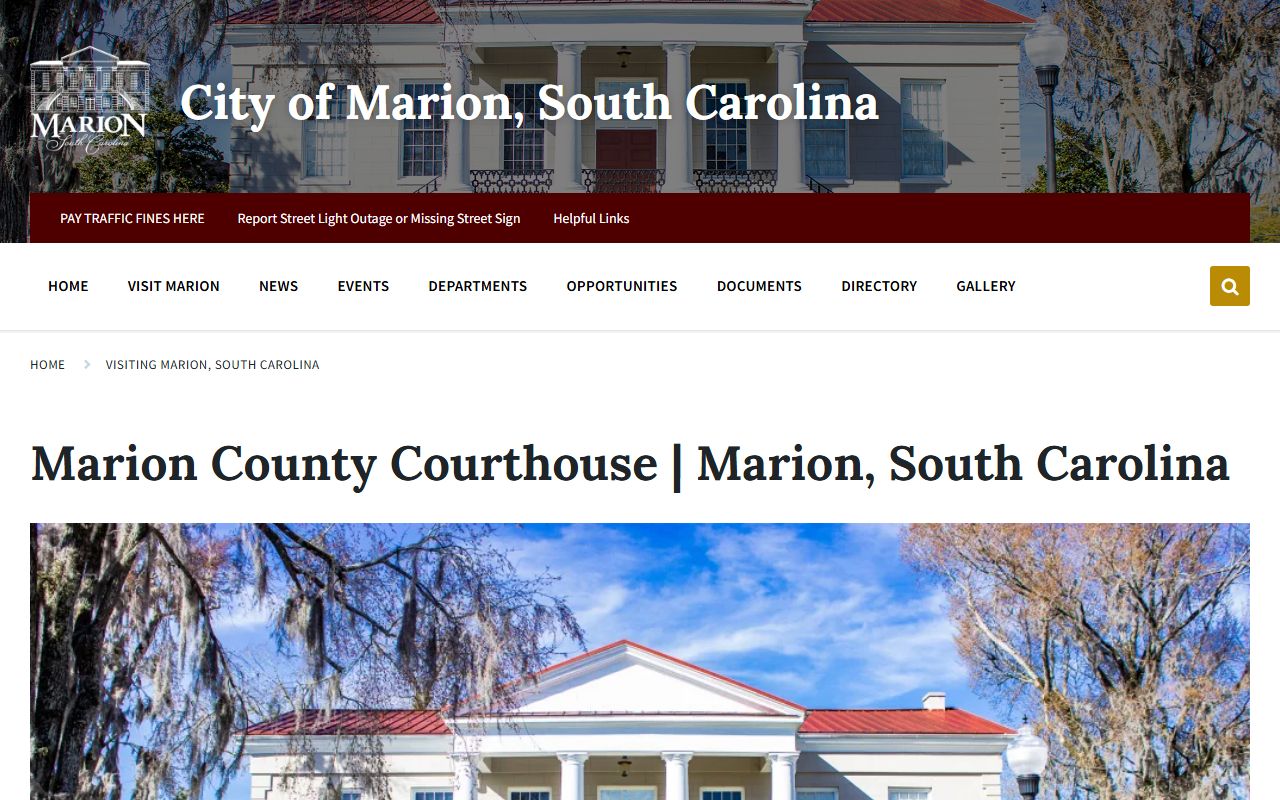
The courthouse history helps place Marion County Court records in context, but modern record access still depends on the current office that keeps the file.
Marion County Court Record Types
Marion County Court records include civil, criminal, family, probate, traffic, lower-court, and recording-adjacent files. Circuit civil records may show lawsuits, judgments, liens, motions, orders, and appeals from lower courts. General Sessions records may show charges filed in court, indictments or other charging papers, pleas, dispositions, sentence orders, fines, costs, and docket activity. Family Court records may include divorce, custody, support, alimony, name changes, adoption, termination of parental rights, and juvenile matters, but several of those categories have privacy limits.
Probate Court records include estates, wills, guardianships, conservatorships, marriage licenses, trusts, minor settlements, powers of attorney, and involuntary commitments. Magistrate and Municipal Courts create traffic, small-claims, low-level criminal, bond, preliminary-hearing, city ordinance, and bench-warrant records. The Clerk of Court also serves as Register of Deeds locally, so the same office is tied to deeds, mortgages, liens, plats, financing statements, and powers of attorney. Those recording records can matter for judgment, lien, estate, foreclosure, or property research, but they are not the same as a court docket.
- Criminal court records: General Sessions case files, plea records, dispositions, sentencing orders, fines, and costs.
- Civil court records: Common Pleas lawsuits, judgments, motions, civil orders, liens, and appeals from lower courts.
- Family Court records: divorce, custody, support, alimony, adoption, juvenile, and name-change matters with privacy limits.
- Probate Court records: estates, wills, marriage licenses, guardianships, conservatorships, and involuntary commitments.
- Traffic court records: Magistrate/Summary Court and Municipal Court citations, bonds, dispositions, and payment status.
The South Carolina Judicial Branch Family Court overview explains the domestic and juvenile case types that can affect Marion County divorce and custody record access.
Family Court is often public in limited form, so case status and decree access should be separated from sealed or confidential family details.
What Marion County Court Records Show
A Marion County Court record may show the case number, county, court type, party names, filing date, case type, charge, docket placement, case status, disposition, hearing information, attorneys, and financial obligations. General Sessions examples from the Solicitor docket use a format such as 2024-GS-33-00029, where the year comes first, GS means General Sessions, 33 is Marion County's county number, and the last digits are the case sequence.
Online court records are often index records rather than full courthouse files. A result may identify the case and key docket events, while images, exhibits, sensitive filings, or certified copies remain with the Clerk. Rule-based redaction can hide Social Security numbers, taxpayer IDs, driver license numbers, financial account numbers, protected addresses, full birth dates, certain minor names, and other identifiers. Public Index availability does not mean every document image is public online.
| Field | What It Shows |
|---|---|
| Case Number | Year, court division, Marion County number, and sequence where that format is used |
| Parties | Plaintiff, defendant, petitioner, respondent, or criminal defendant names when public |
| Filing or Event Date | When the case opened or when a docket event was entered |
| Charge or Cause | Criminal charge, civil case type, family matter, probate matter, or traffic citation type |
| Disposition | Outcome such as judgment, dismissal, plea, conviction, acquittal, or nolle prossed charge |
| Financial Obligations | Fines, costs, support, restitution, bonds, or other payment entries when part of the record |
Marion County Court Public Access
Public access in Marion County can mean an online court index, a courthouse file, a certified-copy request, a Family Court portal result, a Probate Court form route, a traffic-payment lookup, or a county FOIA request. South Carolina FOIA supports inspection and copying of public records, but the correct custodian still matters. Court records should normally start with the court office that keeps the file, while county administrative, sheriff, detention, and non-court records may use the countywide written request process.
Marion County's FOIA process requires written requests submitted in person, by mail, email, or fax. Requests should describe existing records, not ask the county to answer questions. The county gives an initial determination within 10 business days for records no more than 24 months old and within 20 business days for older records. Production runs 30 calendar days for newer records and 35 calendar days for older records after notice or deposit. A deposit up to 25 percent may be required.
Key access rules:
S.C. Code Section 30-4-30 gives the public a right to inspect or copy public records unless an exemption applies.
S.C. Code Section 30-4-40 lists exemptions and redaction grounds that can limit release of protected records.
South Carolina Rule of Civil Procedure 41.2 requires privacy redactions in court filings and can affect public index images.
S.C. Code Section 17-1-40 treats expunged arrest, charge, and conviction materials as sealed or destroyed rather than ordinary public records.
The official South Carolina Association of Counties Marion County profile identifies Marion as the county seat and gives local government context for record routing.
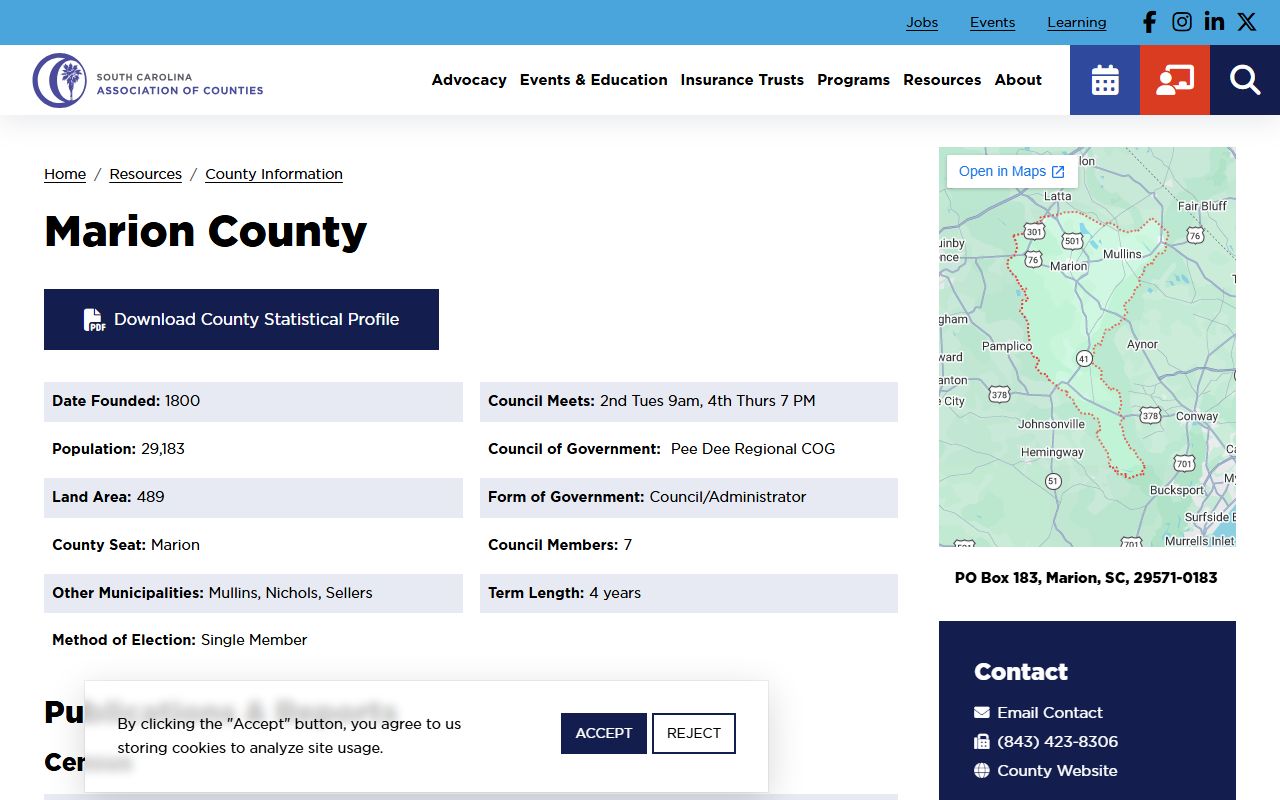
County-level context is useful because some record routes are local government records, while court cases follow Judicial Branch and court-custodian rules.
Restricted Marion County Court Records
Some Marion County Court records are public only in part, and some are not public without a court order or statutory authority. Juvenile records are confidential under South Carolina juvenile law and generally open only by court order to people with a legitimate interest. Adoption hearings and adoption papers are confidential and sealed except by court order for good cause. Mental-health and involuntary-commitment matters are Probate Court matters, but medical and mental-health confidentiality rules apply.
Expunged records are also different from ordinary public records. South Carolina Judicial Branch materials define expungement as removal of a criminal conviction or charge from a person's record and sealing or destruction of state arrest, charge, or conviction records. General Sessions expungements start with the Solicitor for the circuit where the offense occurred. Marion County is in the 12th Circuit, so eligible General Sessions requests route through that circuit's Solicitor process.
Note: A case can be visible online while specific images, identifiers, exhibits, addresses, juvenile details, or sealed orders remain unavailable.
Marion County Sheriff and Jail
Marion County Sheriff J. Brian Wallace leads the Sheriff's Office, which provides law enforcement, detention, court security, and civil services. The Sheriff's Office address is 1811 N. 501 Bypass, Marion, SC 29571, with phone (843) 423-8216 Option 2. The Marion County Detention Center is at 2715 East Highway 76, Ste D, Mullins, SC 29574. The center houses people awaiting trial, people sentenced to 90 days or less, and family-court sentenced inmates.
Jail records are not the same as final court records. The booking process may collect identification data, charge and bond data, property records, hold, warrant, detainer and extradition data, photographs, fingerprints, DNA samples when required, medical screening, and release records. The county says the detention database feeds MobilePatrol, VINE, and other public-information sites. Bond hearings are normally held by the Magistrate's Office, and release can be delayed by NCIC checks, warrants, detainers, victim notification, General Sessions paperwork, or SCDC processing.
The Marion County Detention Center is the county source for jail structure and custody information. The South Carolina Association of Counties Marion County directory also confirms local official contacts for Sheriff and other county offices.
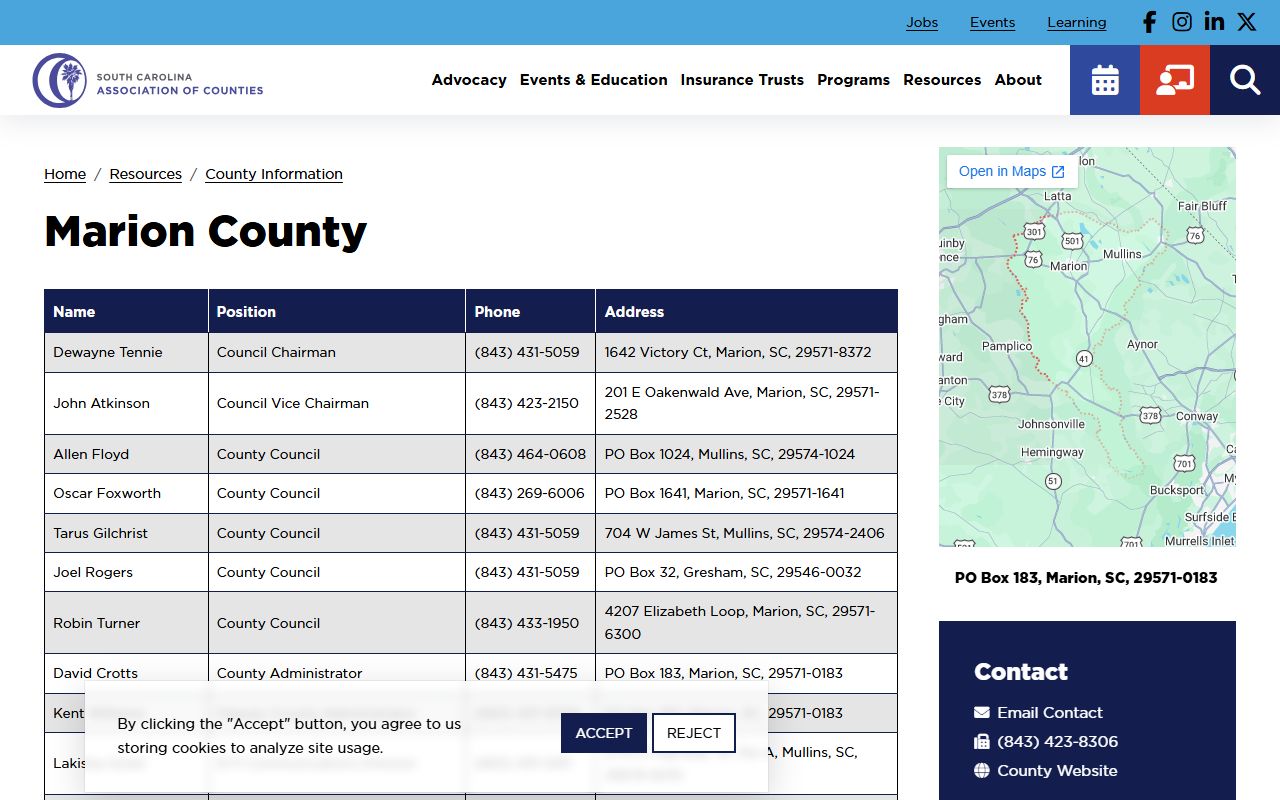
For a custody snapshot, start with the county jail route; for final charges or sentencing, check the court file that owns the case.
Marion County Traffic and Warrants
Traffic records in Marion County can belong to Magistrate/Summary Court or to a Municipal Court in Marion, Mullins, Nichols, or Sellers. The Clerk of Court does not handle traffic ticket payments. County online payment applies only when the ticket address is 2715 E. Highway 76, Mullins, SC 29574. If the ticket lists a different court, the user must contact the court shown on the ticket. The county payment flow uses last name and the case number printed in red on the bottom of the ticket, with all letters and numbers and no spaces.
Warrant access is more limited. No official Marion County Sheriff active warrant search was found in the research. The Sheriff's Civil Process and Warrants page confirms service of warrants and related process, and Magistrate Court handles bench warrants after failure to appear or failure to post bond in criminal cases. The City of Marion Police Department app includes most-wanted and tip features, but it is a city-police channel, not a countywide Sheriff warrant database. SLED CATCH is a criminal-history search, not a warrant lookup.
| Question | Best First Route | Why |
|---|---|---|
| County traffic ticket payment | Marion County Central Traffic Court | Use only if ticket address is the Mullins Summary Court address |
| City traffic ticket | Named Municipal Court | Marion, Mullins, Nichols, and Sellers are excluded from the county payment path |
| Failure to appear | Magistrate or Municipal Court listed on notice | Can lead to suspension notice or bench warrant |
| Active warrant concern | Court or Sheriff's Office phone/in-person channel | No official public county active-warrant search was located |
The county's traffic-ticket payment instructions explain when Marion County online payment can be used.
Marion County Marriage and Probate
Marriage licenses are Probate Court records in Marion County. South Carolina law requires a written marriage-license application to be filed with the probate judge at least 24 hours before issuance. Both parties sign the application, and state law requires the probate judge or clerk to keep it permanently. Certified marriage certificates are available through South Carolina DPH, but that vital-record product is not the same as the Probate Court application file.
Divorce records follow a different path. Divorce cases are Family Court matters, and certified divorce decrees come from the Clerk of Court in the county where the divorce was filed or granted. South Carolina DPH provides certified divorce reports, which may confirm a divorce event but do not replace the decree, parenting terms, property orders, support orders, or other court-file content. Probate files, estate petitions, guardianships, conservatorships, and involuntary-commitment matters use Probate Court and statewide probate forms.
- Testator
- A person who made a will.
- Personal representative
- The person appointed to administer an estate.
- Conservator
- A person appointed to manage money or property for a protected person.
- Guardian
- A person appointed to handle personal care decisions for a minor or incapacitated person.
The South Carolina Judicial Branch Probate Court overview describes the statewide probate role used by Marion County.
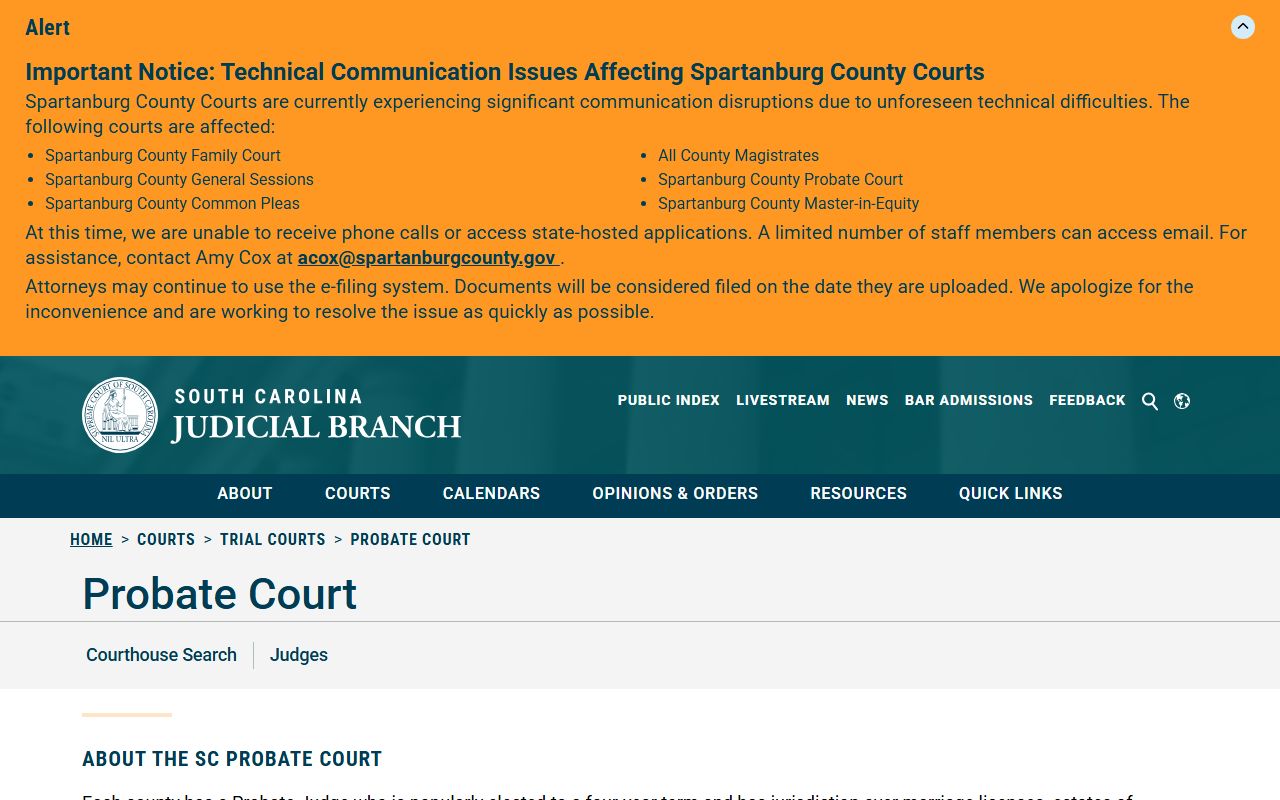
Probate records can be public, restricted, or form-driven depending on whether the matter is an estate, marriage license, guardianship, conservatorship, or commitment proceeding.
Marion County Court Records Fees
Fee rules vary by record custodian. The Clerk page gives a narrow Register of Deeds copy rule of $5 per document, payable by cash, money order, cashier's check, or business check to Marion County Clerk of Court, with personal checks not accepted. The county FOIA process lists copies at $0.20 per page, USB flash drives at $5 per device, and search, retrieval, and redaction at the hourly rate of the lowest-paid qualified staff member. Probate fees follow state fee statutes, while SCDMV driver records are a separate state product.
| Item | Amount or Rule |
|---|---|
| Register of Deeds document copy | $5 per document |
| FOIA paper copy | $0.20 per page |
| FOIA USB flash drive | $5 per device |
| FOIA staff time | Hourly rate of the lowest-paid qualified staff member |
| FOIA deposit | Up to 25 percent of anticipated cost |
| SCDMV full driving record | $10 through SCDMV channels |
Interpret Marion County Court Records
Several South Carolina court terms are easy to misread. Common Pleas is the civil side of Circuit Court, while General Sessions is the criminal side. Summary Court usually means Magistrate and Municipal Courts. A disposition is the outcome of a case or charge. Nolle prossed means the prosecutor chose not to proceed. Dismissed means the case or charge ended before judgment. Not guilty means an acquittal or non-conviction, while guilty means a conviction or plea accepted by the court.
Charge information should not be treated as a final result. A jail booking may show an arrest charge, a court record may show a filed charge, and a criminal case may later show a plea, dismissal, nolle prosequi, acquittal, amendment, or sentence. For civil matters, a judgment or order is different from a filing. For traffic, a court payment record is different from an SCDMV driver record, points total, suspension status, or insurance effect.
Marion County Record Limits
Online Marion County Court records have timing and access limits. Public Index applications may require browser settings. Court rosters can change after a continuance, plea, dismissal, emergency order, or clerk update. Traffic tickets may not appear for one to two weeks if the officer has not filed the ticket. Jail booking records can change after bond hearings, holds, detainers, release checks, or SCDC processing. Older court and probate records may not be in current web portals at all.
The U.S. Census QuickFacts page for Marion County supplies current county demographic context, not court-case data.
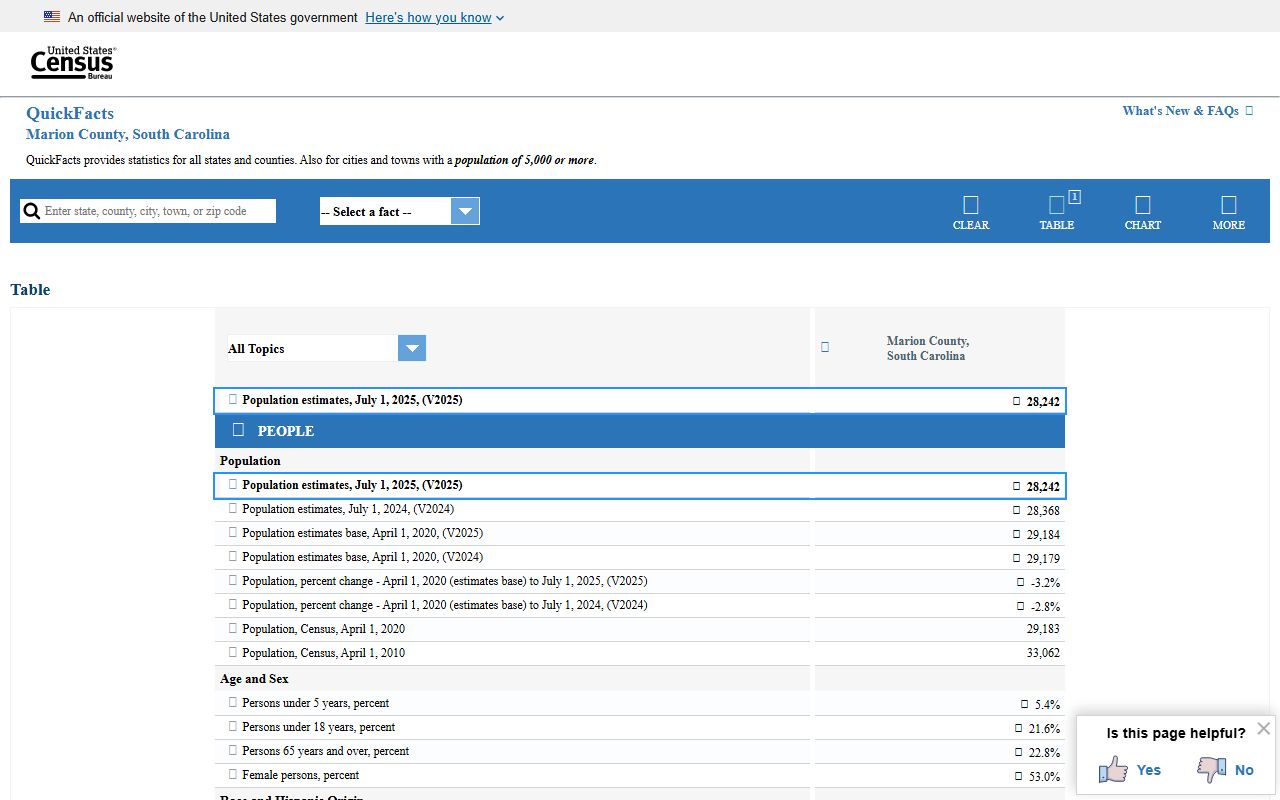
Population and county context help describe Marion County, but official case status must still come from the court, jail, or state agency that owns the record.
Note: Confirm deadlines, hearing dates, payment status, and certified-copy rules with the issuing office before relying on an online entry.
Historic Marion County Court Records
Marion County was founded in 1800, with Marion as the county seat. The county's court history is tied to the square in downtown Marion. The first courthouse was completed in 1800. The present courthouse was completed in 1853, and the Old Records Building was constructed in 1903 as a fireproof records building. It housed Clerk of Court and Probate Judge offices until 1979 and now serves as part of the county's archives and history setting.
The City of Marion's local history page connects the courthouse square to the broader history of Marion, once known as Gilesborough.
Historical researchers should account for old record locations, name changes, former surnames, and the difference between archival files and current court portals.
Marion County Court Officials
Several named offices appear across Marion County record research. Christy M. Gray is the Marion County Clerk of Court and Register of Deeds. The Clerk keeps court records for Circuit and Family Court, supports juries, collects court-ordered obligations, and handles a local recording function through Register of Deeds. Probate materials identify T. C. Atkinson, III or T. Carroll Atkinson, III in official sources, while the county Probate page also lists county Administration Building contact details, Associate Probate Judge Samantha Woodberry, and Probate Judge Clerk Amanda Page.
The South Carolina Association of Counties directory helps confirm local official names and numbers for Clerk, Probate, Sheriff, and other county offices. Use the office title and record type together when calling, because the Clerk, Probate Court, Sheriff, Detention Center, Magistrate Court, and Municipal Courts hold different records.
Marion County Court Records FAQ
Where do Marion County Court records start online?
Most public trial-court searches start with the South Carolina Judicial Branch case-record search and the Marion County Public Index. Family Court, Probate Court, traffic tickets, jail custody, and vital records may require different channels.
Who keeps certified Marion County divorce decrees?
Divorce decrees are Family Court records requested through the Clerk of Court in the county where the divorce was filed or granted. DPH divorce reports are separate vital-record products.
Does Marion County have an active warrant search?
No official Marion County Sheriff active warrant search was found in the research. Confirm warrant concerns with the correct court or Sheriff's Office channel, and do not use SLED CATCH as a warrant lookup.
Can the Clerk take traffic ticket payments?
No. The Clerk page says the Clerk does not handle traffic ticket payments of any kind. Use the court shown on the ticket, and use the county online payment route only when the ticket address matches the Mullins Central Traffic Court address.
Where are older Marion County records?
Older court and probate materials may not be online. The Old Records Building and Marion County Archives context is important for early records beginning in 1800, but current certified copies still depend on the office that owns the file.